


Insights with Ivor
October 2026
Dept. of Medicine faculty, staff, residents, & colleagues
Why is giving and receiving feedback such a challenging task for academic faculty (and our trainees)?
“We do want to learn and grow. And we also want to be accepted just as we are right now.”
— Douglas Stone and Sheila Heen, Thanks for the Feedback: The Science and Art of Receiving Feedback Well (2014)
Feedback has been defined as an informed, nonevaluative, and objective appraisal of performance and is given on the basis of formative assessments and is primarily intended to reinforce strengths, address weaknesses and improve clinical skills.
-
Feedback sits at an uncomfortable intersection. We seek both to learn and grow, while also wanting to feel competent, respected, and accepted as we are. In academic medicine, that tension is heightened by the stakes of our work and the generally high level of competence amongst our trainees and colleagues. A conversation about clinical reasoning, communication, teaching, or professionalism can quickly feel like a judgment about identity or belonging. The faculty member may worry about damaging the relationship; the trainee or peer may hear a verdict rather than an invitation to improve. These tensions are not unique to our learners and colleagues. They are familiar to all of us, at every stage of an academic career.
The framework of Crucial Conversations helps explain why feedback is so challenging. The stakes are high, perspectives may differ, and emotions can be strong. Under pressure, we may retreat into silence by postponing, softening, or withholding an important message. At other times, urgency may push us toward language that feels controlling, categorical, or personal. Neither response promotes learning.
Our goal is not to remove all discomfort. It is to create enough safety for candor and to communicate that we respect the learner, share a commitment to ezxcellent patient care, and believe improvement is possible. This starts with relationships and clear expectations. Learners are more likely to engage when they know that we understand their goals, have observed their work, and are invested in their development.
Specificity is central to that trust. “Good job” offers encouragement but little direction; “read more” identifies neither the gap nor the next step. Likewise, a label such as “disorganized” can feel personal and final. A more useful approach begins with what we observed, explains why it matters, and invites the learner’s perspective.
Robert Burns on the gift of seeing our blind spots
“O wad some Pow’r the giftie gie us
To see oursels as others see us!”
(Oh, would some power give us the gift of seeing ourselves as others see us.)— “To a Louse, On Seeing One on a Lady’s Bonnet at Church” (1786).
-
When a conversation feels difficult, we can begin plainly and respectfully: “I would like to discuss an observation because I want to support your development and maintain excellent patient care. During today’s presentation, I noticed [specific behavior]. I am concerned that [impact or risk]. How did you see the situation? Let us agree on what you will try next and when we will reassess it.”
The heart of a crucial conversation is to start with our shared purpose, distinguish observation from interpretation, listen for information we may not have, and move toward a specific plan. Feedback is not complete when we have delivered a message. It is complete when faculty and learner share an understanding of the standard, the gap, and the next action. By being direct without being dismissive we seek to preserve respect, invite dialogue, and make clear that the purpose of the conversation is growth.
Importantly feedback should occur early enough for the learner to act and NOT for the first time in the final evaluation.
-
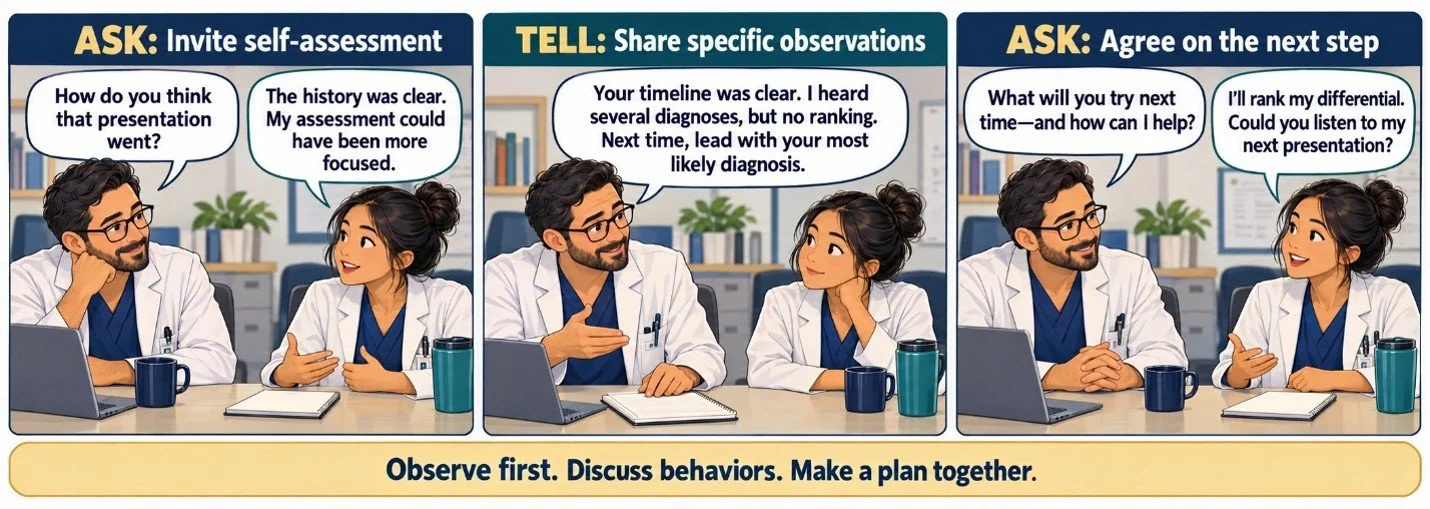
Ask: Encourage self-reflection; Assesses learner insight.
“What are you working on, and how do you think it is going?”
Tell/Coach: Describe what you observed, explain its impact, and clarify what should continue or change. Build on self-assessment by reinforcing effective behaviors and offering specific, constructive guidance.
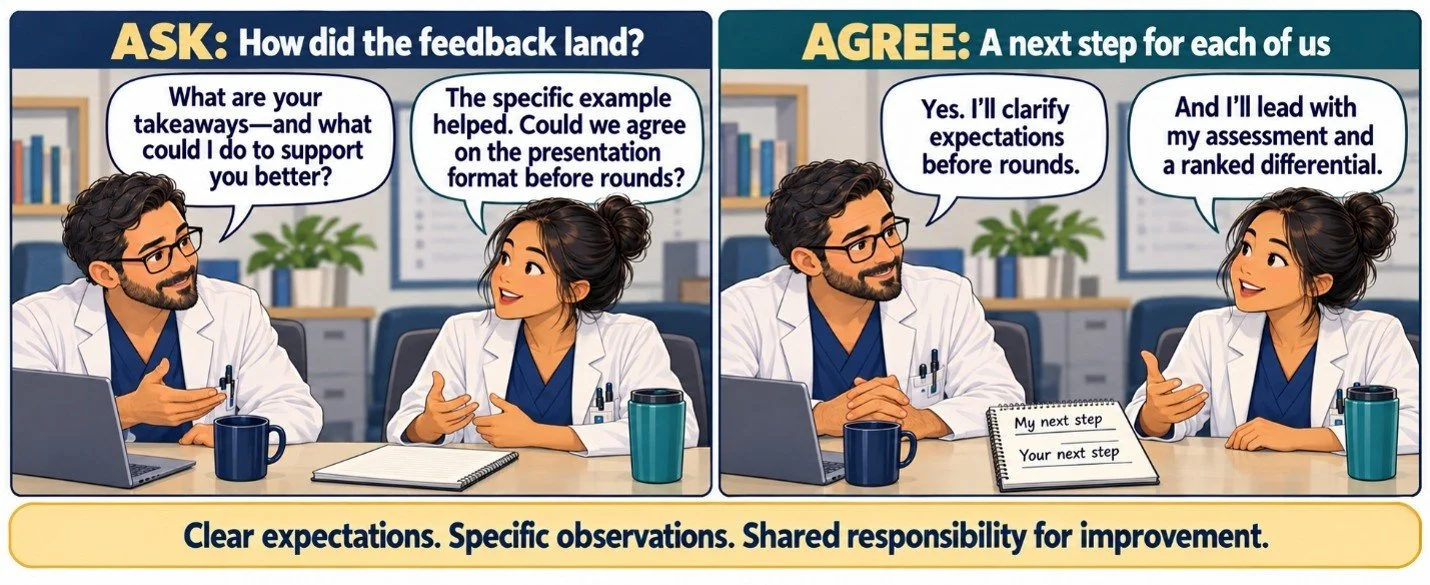
Ask: Confirm understanding, agree on the next step, and set a time to reassess.
-
I am asking each of us to make this a dependable part of clinical teaching.
Every clinic block and inpatient rotation should begin with explicit learning goals.
Provide brief, behavior-based coaching in real-time whenever feasible.
Every rotation lasting one week or longer should include purposeful feedback during the experience and a closing conversation using Ask-Tell/Coach-Ask.
The written evaluation should reinforce, not reveal, the substance of those discussions.
Invite the learners to reflect on the learning environment and offer feedback (360˚).